

Oak Silkworm Eggs Use a Natural Chemical Defence to Keep Parasitic Wasps Away
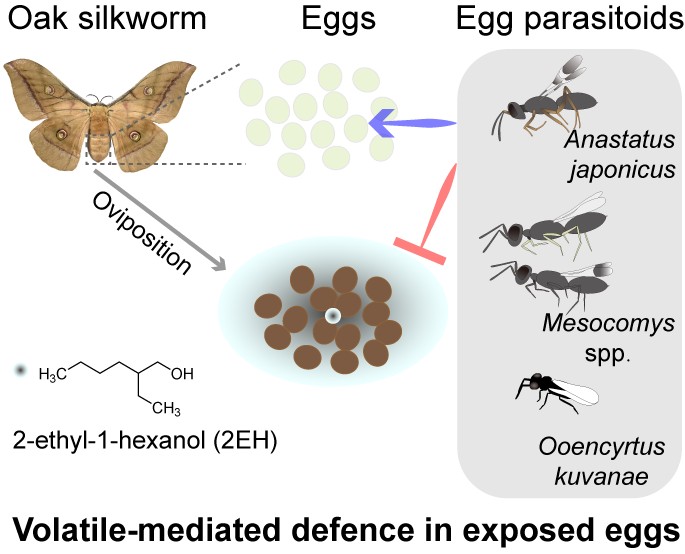
Fig. 1: Eggs of the oak silkworm Antheraea pernyi are associated with the volatile compound 2-ethyl-1-hexanol (2EH), which repels egg parasitoids and reduces successful parasitism. The findings reveal a volatile-mediated defence mechanism in exposed insect eggs.
New research uncovers how exposed silkworm eggs protect themselves without physical coverings, offering new clues for greener pest management.
The study, published in Insect Science, found that naturally laid eggs of the oak silkworm (Antheraea pernyi) produce a volatile compound called 2-ethyl-1-hexanol (2EH). The compound acts as a natural repellent, reducing the likelihood that parasitic wasps will approach or lay their eggs in the silkworm eggs.
The finding helps explain a surprising difference observed by researchers: naturally laid eggs experience much less parasitism than eggs that are manually removed and washed in the laboratory.
Field experiments showed that naturally laid eggs were attacked far less frequently by three species of parasitoid wasps. The specialist Mesocomys trabalae almost completely avoided intact eggs, while Anastatus japonicus made fewer contacts and oviposition attempts.
Researchers then used behavioural tests and chemical analysis to investigate the reason for this avoidance. They identified 2EH as a distinctive compound associated with naturally laid eggs. Both wasp species could detect the chemical and showed avoidance behaviour when exposed to it. Most importantly, applying 2EH to washed eggs significantly reduced parasitism, confirming that the compound plays a key role in protecting the eggs.
The discovery provides a new perspective on how insects protect their offspring. While some insects hide their eggs or cover them with protective materials, the oak silkworm appears to use a chemical signal to make its exposed eggs less attractive to potential attackers. The findings could also have practical applications. Oak silkworm eggs are widely used as alternative hosts for mass-rearing parasitoid wasps used in biological control programmes. Understanding the repellent effect of 2EH could help researchers optimize these systems.
The naturally occurring compound may also provide a starting point for developing environmentally friendly insect repellents or pest-management approaches that target insects' smell-based behaviour. Further research is needed to determine whether similar chemical defences occur in other insect species.
About the Research Team:
The study was led by Prof. Lian-Sheng Zang at the State Key Laboratory of Green Pesticides, Guizhou University, with doctoral candidate Hai-Xia Zhan as first author. Researchers from the Guangdong Academy of Sciences, Beijing Academy of Agriculture and Forestry Sciences and international collaborators, including Prof. Guy Smagghe, also contributed.
Read the full article here: https://onlinelibrary.wiley.com/doi/10.1111/1744-7917.70355
Andrew Smith
Charlesworth Yansci
+44 7753 374162
marketing@charlesworth-group.com
Visit us on social media:
Bluesky
X
Other
Legal Disclaimer:
EIN Presswire provides this news content "as is" without warranty of any kind. We do not accept any responsibility or liability for the accuracy, content, images, videos, licenses, completeness, legality, or reliability of the information contained in this article. If you have any complaints or copyright issues related to this article, kindly contact the author above.
