

2026 Proxy Season Review: Submission of Rule 14a-8 Shareholder Proposals
Summary of Key Trends[1]
A. Submission of Rule 14a-8 Shareholder Proposals
- The SEC recently proposed to eliminate Rule 14a-8 shareholder proposals, but the proposed rulemaking will not affect shareholders’ right to submit Rule 14a-8 proposals for the core 2027 proxy season.
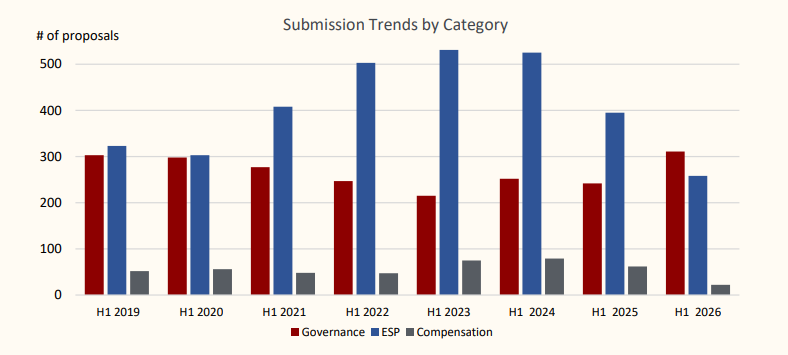
- Total submissions fell by ▼15% in H1 2026, with environmental, social and political (“ESP”) and compensation proposals decreasing by ▼35% and ▼65%, respectively, while governance proposals increased by ▲29%.
- Governance proposals represented the majority of submissions for the first time since 2012, driven by a ▲227% increase in independent chair proposals and a ▲410% increase in written consent proposals.
- Proposals related to diversity, equity and inclusion topics decreased by ▼61%.
- AI-related proposals increased by ▲122% and covered a broader range of governance and ESP issues.
- Notwithstanding the overall drop in submissions, the number of proposals from Chevedden and “anti-ESG” proponents remained level, accounting for 42% and 19% of total submissions, respectively.
B. Exclusion of Proposals: SEC and Courts
- The SEC staff largely suspended its review of proposal exclusions this proxy season; under this new process, notices to exclude shareholder proposals declined by ▼51%.
- Proponents sued six companies for excluding proposals, obtaining a preliminary injunction in one case.
C. Pre-Meeting Investor Engagement & Proxy Advisor Developments
- Exempt solicitation filings dropped by ▼49% after the SEC staff announced it would object to voluntary filings from small shareholders.
- ISS recommended in favor of ▲12% more shareholder proposals, with governance proposals accounting for 85% of “FOR” recommendations.
- The largest institutional investors bifurcated stewardship teams, expanded pass-through voting and announced in-house voting platforms that were designed to decrease the influence of proxy advisor recommendations.[2]
- SEC permits companies to expand retail voting by allowing retail investors to set a standing instruction to vote with management’s recommendation for future meetings.
D. Voting Outcomes
- With fewer exclusions and settlements this season, 63% of submissions reached a vote.
- No ESP proposals passed for the first time in over a decade, while overall shareholder support remained level (23% v. 22% in H1 2025) and the number of passing proposals decreased by ▼49%.
E. Additional Considerations
- Although the total number of proposed reincorporations across U.S. public companies remained low (22 in H1 2026), proposed Delaware-to-Texas reincorporations nearly doubled in H1 2026.
- M&A-driven activism was the defining feature of activism in the 2026 proxy season, with push-for-sale demands at U.S.-based companies increasing by almost ▲50% v. H1 2025.
- Pending SEC regulatory reforms will reshape the proxy season landscape.
A. Submission of Rule 14a-8 Shareholder Proposals
Regulatory Background[3]
- February 12, 2025: SEC staff issued Staff Legal Bulletin 14M (“SLB 14M”), reversing its prior approach to the ordinary business and economic relevance exclusions by requiring proponents to tie their proposals, even ones implicating broad policy issues, to the company’s specific business.
- June 12, 2025: SEC formally withdrew its 2022 proposed rulemaking that would have narrowed the availability of the substantial implementation, duplication and resubmission exclusionary bases.
- September 4, 2025: As part of its rulemaking agenda, the SEC announced that it is considering amendments to Rule 14a-8 “to reduce compliance burdens for registrants and account for developments since the rule was last amended.”
- October 9, 2025: SEC Chairman Paul Atkins indicated that precatory proposals submitted to a Delaware company may be excludable under Rule 14a-8(i)(1) as being improper under state law.
- November 17, 2025: SEC staff announced that, for the 2026 proxy season, it would no longer substantively review most no-action requests or express views on any basis for exclusion other than Rule 14a-8(i)(1).
- December 11, 2025: Executive Order 14366 directed the SEC Chairman to review all rules, regulations, guidance, bulletins and memoranda relating to proxy advisors and to shareholder proxy proposals, including Rule 14a-8, and to consider revising or rescinding those that are inconsistent with the executive order.
- August 14, 2026: SEC staff announced that it will no longer respond to any Rule 14a-8 no-action requests.
- September 16, 2026: SEC proposed to rescind Rule 14a-8 in its entirety.
Key Implications. The SEC and its staff have moved systematically to reduce federal involvement in the process by which shareholders make proposals to a public company’s shareholder base, culminating in last week’s proposal to rescind Rule 14a-8. Although a rescission would not affect proponents’ right to make Rule 14a-8 proposals in the core 2027 proxy season, proponents are likely to use the upcoming season to begin the process of private ordering in this area. As a result, prior season trends may be less correlated with those in the upcoming season, but we expect at least some of the 2026 proxy season trends to continue. For example, we expect proponents to continue to focus on “tried-and-true” governance proposals and largely pivot away from “test-the-water” proposals (other than in the case of AI).
1. The SEC recently proposed to eliminate Rule 14a-8 shareholder proposals, but the proposed rulemaking will not affect shareholders’ right to submit Rule 14a-8 proposals for the core 2027 proxy season.
Last Wednesday, the SEC released a proposal to rescind Rule 14a-8. This proposed rulemaking, if adopted as proposed, would eliminate Rule 14a-8 in its entirety. In addition, it includes proposed amendments to Rule 14a-4 and other federal proxy rules that would give companies greater flexibility to decide whether to include shareholder proposals as individualized voting items on the company’s proxy card.[4]
Rule 14a-8 remains in effect and will continue to apply unless and until the SEC adopts a final rule rescinding it after completing a review of feedback received during the 60-day comment period. For many calendar-year companies, the deadline for shareholders to submit Rule 14a-8 proposals falls between November and December 2026. As a result, for their 2027 annual meetings, calendar-year companies will still need to comply with Rule 14a-8 requirements with respect to any shareholder proposal submitted under Rule 14a-8, including notifying the SEC and the proponent of their intent to exclude a Rule 14a-8 proposal at least 80 days before filing a definitive proxy statement. In responding to Rule 14a-8 proposals this proxy season, companies should also be aware that, on August 14, 2026, the staff of the SEC’s Division of Corporation Finance announced that it will no longer respond to any Rule 14a-8 no-action requests.
Although the proposed rescission would not affect the availability of Rule 14a-8 during the core 2027 proxy season, it already has begun to impact the focus of proposals submitted for the upcoming proxy season. For example, in anticipation of Rule 14a-8 reform, several shareholder proponents have submitted shareholder proposals for upcoming meetings requesting companies to commit to including in their annual proxy statement any shareholder proposal otherwise compliant with the procedural and substantive requirements of Rule 14a-8, regardless of future federal regulatory developments.[5] These proposals are similar to the private-ordering proxy access proposals that companies received after Rule 14a-11, which gave shareholders the right to include director nominees in company proxy materials, was vacated in 2011. Those proxy access proposals were prevalent throughout the 2010s and the resulting bylaw provisions, though rarely used in practice, are now relatively common for U.S. public companies.
In the 14 years of publishing our annual proxy season review, our observation has been that prior season results generally tend to be correlated with, and predictive of, major trends in the next proxy season. Given the unique regulatory backdrop of the 2027 proxy season, however, this general rule is less likely to be applicable across the board. Nonetheless, we expect that some of the stronger 2026 proxy season trends we observed will continue to impact submissions and engagement in the upcoming proxy season. For example, we expect proponents to continue to focus on “tried-and-true” governance proposals and largely pivot away from “test-the-water” proposals.
2. Total submissions fell by ▼15%, with ESP and compensation proposals decreasing by ▼35% and ▼65%, respectively, while governance proposals increased by ▲29%.
Last year, the number of submitted proposals fell below 700 for the first time since 2020, decreasing by 19% compared to H1 2024. This year, the decline continued, with 591 proposals submitted (v. 699 in H1 2025), representing a ▼15% year-over-year decrease.[6]
This overall decline, however, reflects sharply different trend lines for the core categories of proposals. Specifically, the number of social/political proposals dropped by ▼35% to 180 (v. 278 in H1 2025 and 365 in H1 2024), the number of environmental proposals dropped by ▼33% to 78 (v. 117 in H1 2025 and 162 in H1 2024) and the number of compensation-related proposals dropped by ▼65% to 22 (v. 62 in H1 2025 and 79 in H1 2024).[7] In contrast, there was a ▲29% increase in the submission of governance proposals (311 v. 242 in H1 2025 and 252 in H1 2024).
Although large-cap companies continued to receive the vast majority of shareholder proposals, the portion of submissions aimed at S&P 500 companies continued to decline (to 76% v. 78% in H1 2025 and 88% in H1 2024). This trend was driven by an increase in governance proposals requesting smaller companies to adopt new shareholder rights (e.g., special meeting and written consent) that tend to be more prevalent at larger companies.
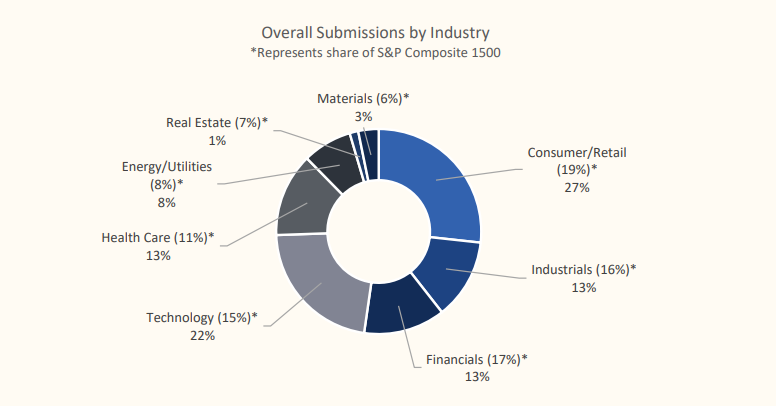
Consistent with last year, the consumer/retail and technology sectors received the largest numbers of proposals. The consumer/retail sector received 56% of environmental proposals in H1 2026, and the consumer/retail and technology sectors each received over 28% of social/political proposals. For governance proposals, each of the consumer/retail and technology sectors received around 20% of submissions in this category, followed by health care companies at 16% of submissions. Almost all proposals from “anti-ESG” proponents[8] were targeted at companies in the consumer/retail, technology, financial and industrial sectors.
3. Governance proposals represented the majority of submissions for the first time since 2012, driven by a ▲227% increase in independent chair proposals and a ▲410% increase in written consent proposals.
In H1 2026, governance proposals represented 53% of submissions (v. 35% H1 2025). In each previous proxy season throughout the last decade, ESP proposals had represented the majority of submissions, although the portion of governance proposals has increased steadily since H1 2023.

There were two main drivers of the increase in governance proposals during the 2026 proxy season. First, proponents focused on three structural governance topics that resulted in passing[9] proposals in the 2025 proxy season: special meetings (18% of all H1 2026 governance proposals), written consent (16% of all H1 2026 governance proposals) and majority voting (10% of all H1 2026 governance proposals). Majority voting was the topic that garnered the highest number of passing votes last proxy season (with 73% average support), which likely contributed to the sustained level of submissions this year. Written consent proposals increased by ▲410% this year, all but two of which were proposals to adopt a new right. While the overall number of special meeting proposals declined by ▼16%, it is notable that proposals to amend an existing special meeting threshold decreased by ▼26%, while proposals to adopt a new special meeting right remained level.[10]
Second, there was a growing proportion of proposals with a headlining governance issue but overtly ESP-focused supporting statements. We observed the clearest examples of this trend in the independent chair proposals submitted this year, which increased by ▲227% compared to H1 2025 even though no independent chair proposal passed last proxy season. Comparing 2026 independent chair proposals to proposals submitted by the same proponents at the same companies in 2024 and 2025, we observed that many of the 2026 proposals tended to have supporting statements that highlighted individualized incidents involving the company or its CEO, including lawsuits, reported scandals, ESP issues or other company-specific developments. In contrast, earlier proposals on this topic largely used standardized language, including citations to proxy advisor policy statements about the benefits of independent chairs. This trend may have been driven in part by the low support for ESP proposals in the 2025 proxy season (11% average shareholder support for both social/political and environmental proposals), and in part by the SEC’s guidance in SLB 14M that proposals must be company-specific in order to avoid being excluded under Rule 14a-8.
As discussed above, we expect a “test-the-waters” focus of 2027 proposals to be requests for the adoption of Rule 14a-8-like proxy access rights in companies’ organizational documents. In addition, we expect the focus on “tried-and-true” governance proposals to remain in submissions for the 2027 proxy season. For example, at least some proponents may continue to submit written consent, special meeting and majority voting proposals, all of which received substantial shareholder support this season and could be used to support arguments regarding the importance of maintaining the federal shareholder proposal right under Rule 14a-8. In particular, proponents may be encouraged to submit more written consent proposals at companies that do not currently provide a shareholder right to act by written consent, since average shareholder support increased by ▲10% (to 36% of votes cast) and three proposals passed (all proposals to adopt new rights) compared to one in H1 2025. For special meeting proposals, average shareholder support increased by ▲7% (to 39% of votes cast), and four proposals passed (all proposals to adopt new rights), compared to nine in H1 2025 comprising a mix of “adopt” and “amend” proposals. Average shareholder support for majority voting proposals decreased by ▼17% but was still substantial at 56% of votes cast, with seven proposals passing compared to 18 in H1 2025. In contrast, it remains to be seen whether independent chair proposals will remain prevalent. Average shareholder support for independent chair proposals dropped by a further ▼7% (to 24% of votes cast) and none passed.
4. Proposals related to DEI topics decreased by ▼61%.
Proposals focused on corporate diversity, equity and inclusion (“DEI”) efforts fell from 99 in H1 2025 to 39 in H1 2026, representing a significantly steeper decline than the ▼6% decrease between H1 2024 and H1 2025. Similar to last proxy season, 36% of these proposals were submitted by “anti-ESG” proponents. The decline in these proposals may have been due to both the perceived effect of SLB 14M on the excludability of ESP proposals and the low support for these DEI-related proposals last year. During the 2025 proxy season, DEI-related proposals received 7% average support (with proposals from “anti-ESG” proponents garnering an average of 2% support and other proposals receiving 14% average support). The continued decrease in shareholder support for these proposals in 2026, which fell to 4% average support (with proposals from “anti-ESG” proponents garnering an average of 1% and other proposals receiving 11% average support), may lead to another season of subdued submissions on the DEI-related topics that were prevalent in past years, including anti-discrimination policies, EEO-1 reporting and wage gap. Proponents may also continue to explore DEI-related issues in the context of other topics, as they did this proxy season. For example, charitable-contribution proposals increased ▲25% (to 20) in H1 2026, bolstered by proposals from “anti-ESG” proponents that were focused on a company’s association with organizations such as the Southern Poverty Law Center and/or the Human Rights Campaign.
After DEI-related proposals, the social/political topic that saw the largest year-over-year decrease this proxy season was political spending/lobbying proposals, likely due to these proposals being excluded in meaningful numbers for the first time last season. Although we have generally seen an increase in proposals on this topic in the proxy seasons preceding a mid-term election year, there was a ▼30% decrease in such proposals this year. The shareholder support for these proposals continued to be substantial, averaging 27% of votes cast (v. 28% in H1 2025 and 21% in H1 2024) and representing the most well-supported social/political topic. However, because none of these proposals passed this year (compared to four in H1 2025), submissions on this topic likely also will remain subdued next proxy season.
5. AI-related proposals increased by ▲122% v. H1 2025 and covered a broader range of governance and ESP issues.
AI-related proposals more than doubled this year (20 total proposals) and covered an expanded range of topics, notwithstanding the low support they received last year (10% average support in H1 2025). In the last two years, when we first observed a meaningful number of AI-related submissions, the core concerns underlying AI-related proposals were data privacy and board oversight. In H1 2026, AI-related proposals also covered the topics of exploitation, agentic AI, cybersecurity defenses against AI-enabled threats, military AI applications, workforce impacts of AI and the environmental and social implications of data center development, including their climate impact, financial impact and effects on customers. In addition, proposals from “anti-ESG” proponents requested reports on political or religious bias in AI models, the risk of censorship of legitimate speech and the improper or unethical use of external data to train AI. As with prior years, AI-related proposals remained heavily concentrated at a small group of mega-cap technology and media companies.
Shareholder support for these proposals remained muted (8% average support) and none passed, but we do not expect investor interest in AI-related topics to fade. Indeed, in view of the intense media and political focus on AI, there could be a substantial increase in the volume and variety of AI-related proposals next year, although we have seen growing investor and regulatory engagement on AI-related topics outside the Rule 14a-8 process, including with respect to data centers. In addition to board oversight of AI strategy, there has been greater attention this year on how AI tools are being used in the boardroom. As a result, companies should be prepared to engage not only on how their board oversees AI-related risks and opportunities in terms of their governance framework, corporate policies, board education and director qualifications, but also on how directors use AI, including the guardrails that have been implemented.
6. Notwithstanding the overall drop in submissions, the number of proposals from Chevedden and “anti-ESG” groups remained level, accounting for 42% and 19% of total submissions, respectively.
Shareholder proposal activity remains highly concentrated among a handful of serial individual proponents, most notably John Chevedden, who submitted 42% of all proposals (v. 32% in H1 2025) this season and roughly 70% of governance proposals (v. 56% in H1 2025). Proposals from “anti-ESG” proponents made up 19% of submitted proposals in H1 2026 (v. 17% in H1 2025), and constituted a greater portion of ESP proposals this year. The three most prevalent “anti-ESG” proponents were the National Legal and Policy Center, the National Center for Public Policy Research and the Heritage Foundation, which collectively accounted for 61% of proposals from “anti-ESG” proponents.
Link to the full report can be found here
1Unless otherwise noted, the shareholder proposal data we discuss in this publication reflects proposals for annual meetings of the U.S. S&P Composite 1500 held during the first half of 2026. The data derives in part from Institutional Shareholder Services Inc. (“ISS”) voting analytics and has been supplemented with information published by the SEC, proponents and our independent research, experience and knowledge.(go back)
2In collaboration with MacKenzie Partners, we will publish a summary of institutional voting trends in the coming weeks.(go back)
3The deadline for submitting Rule 14a-8 proposals is 120 days prior to the anniversary of the target company’s proxy statement for the prior year. For most calendar year companies that held an annual meeting in H1 2026, the submission deadline for this year’s annual meeting fell between November 2025 and January 2026.(go back)
4For a more detailed analysis of the proposed amendments and their potential implications, including those related to shareholder proposals made pursuant to a company’s organizational documents, see our publication on this proposed rulemaking.(go back)
5See, e.g., National Legal and Policy Center’s proposal submitted at Procter & Gamble for its October 2026 meeting.(go back)
6Submission data is necessarily incomplete, as some proposal submissions do not become public. The volume of unpublicized proposals may fluctuate from year to year. As a result, the data in this publication on year-over-year changes in submitted proposals should be understood as being directional rather than precise.(go back)
7The decrease in compensation proposals was driven by a ▼72% drop in the x2.99 severance proposals that were prevalent but consistently failed to pass in recent years, as well as a ▼53% drop in ESG-linked compensation proposals.(go back)
8We refer to a proponent as an “anti-ESG” proponent if the proponent’s official website states that it is asking companies to reconsider “ESG” or a “woke/liberal” agenda.(go back)
9In this publication, we refer to a proposal as “passing” if it received a majority of votes cast, regardless of whether this is the threshold for shareholder action under state law or the company’s organizational documents.(go back)
10Board declassification proposals constituted less than 3% of this season’s governance proposals (down from 7% in H1 2025), but represented the most well-supported category of proposals submitted with 89% average shareholder support and 100% of voted proposals passing. Outside of the above-referenced categories, the only other governance proposal that passed this year was a proposal to restrict the board’s ability to adopt poison pills (two proposals were submitted on this topic in H1 2026, whereas none had been in H1 2025).(go back)
Legal Disclaimer:
EIN Presswire provides this news content "as is" without warranty of any kind. We do not accept any responsibility or liability for the accuracy, content, images, videos, licenses, completeness, legality, or reliability of the information contained in this article. If you have any complaints or copyright issues related to this article, kindly contact the author above.
